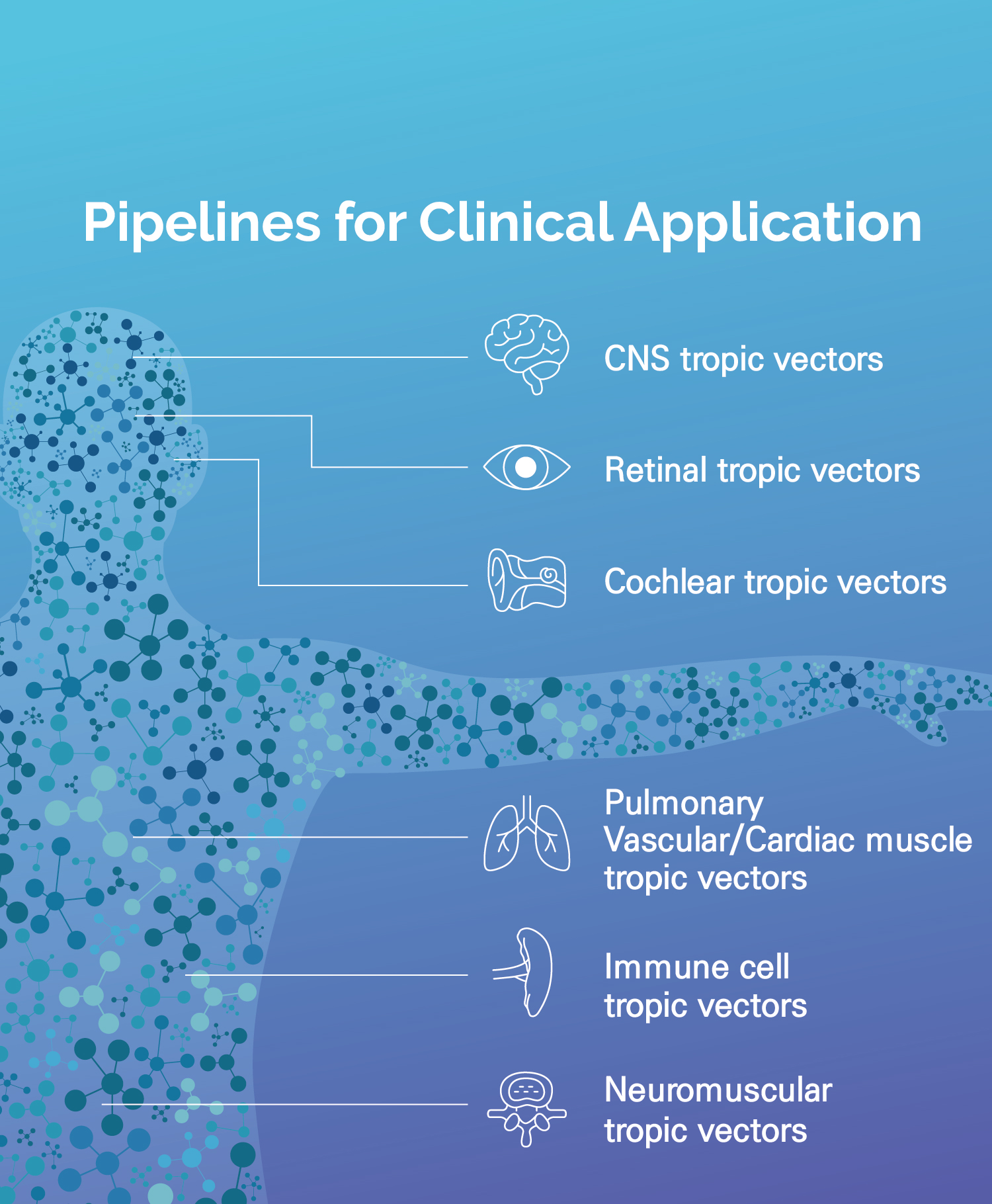
Pulmonary tropic, Vascular/Cardiac muscle tropic Neurodegenerative diseases,
Regenerative medicine
Collaboration with CNS tropic Collaboration with Hereditary Retinal Dystrophy,
Macular degeneration
Retinal tropic Collaboration with in vivo CAR-X (T/NK/Macrophage) Immune cell tropic Hearing loss Cochlea tropic Collaboration with Cystic fibrosis, PAH,
Cardiac gene therapy
Collaboration with CMT-2Z, DMD Neuromuscular tropic Collaboration with Pipelines for Clinical Application

CNS tropic vectors

Applications: Neurodegenerative diseases, Regenerative medicine

Collaborator: Severance Hospital

Cochlear tropic vectors

Applications: Hearing loss

Collaborator: Severance Hospital

Retinal tropic vectors

Applications: Hereditary Retinal Dystrophy, Macular degeneration

Collaborator: Severance Hospital

Pulmonary tropic, Vascular/Cardiac muscle tropic vectors

Applications: Cystic fibrosis, PAH, Cardiac gene therapy

Collaborator: Seoul National University Hospital

Immune cell tropic vectors

Applications: in vivo CAR-X (T/NK/Macrophage)

Collaborator: Seoul National University Hospital

Neuromuscular tropic vectors

Applications: CMT-2Z, DMD

Collaborator: Samsung Medical Center

Featured Pipelines

Pulmonary vessel shuttle vector

Eye(Retina) shuttle vector

CNS(Astrocyte) shuttle vector

GGT-100

An AAV vector (AAVp2CV) with evolutionary specificity for vascular smooth muscle cells and enhanced diffusion throughout the pulmonary system. It is being developed as a potential disease-modifying gene therapy for pulmonary arterial hypertension, a fatal disease with limited effective treatment options.

Innovative Lung Tissue Targeting Specificity

AAVp2CV is the world’s first AAV vector capable of selectively targeting vascular smooth muscle cells—the core pathological target in pulmonary arterial hypertension—through intratracheal administration alone. Rather than relying solely on increased target affinity, this vector introduces a differentiated targeting approach that leverages capsid behavior and distribution within pulmonary tissue.

Advanced Tissue penetration Capability

Demonstrating robust tissue permeability and diffusion across complex pulmonary microenvironments. GGT-100 exhibits a delivery profile distinct from conventional AAV vectors. This property supports stable gene delivery throughout the pulmonary system and expands the scope of potential clinical application.

High Clinical Translation Potential

Enhances tissue penetration and target specificity support translatability from small animal models to large species and human clinical applications. By addressing delivery efficiency challenges commonly observed in larger species, GGT-100 substantially improves the likelihood of clinical success.

Therapeutic Potential

Through selective and efficient gene delivery to vascular smooth muscle cells, GGT-100 is being developed with the potential not only to suppress pulmonary vascular remodeling and prevent progression of pulmonary arterial hypertension, but to reverse it.

GGT-200

An AAV vector that engineered for evolutionary specificity toward photoreceptors, combined with enhanced diffusion across the multilayered retina. It enables efficient gene delivery for a broad spectrum of hereditary and degenerative retinal diseases through intravitreal administration

Innovative Retinal Targeting via Intravitreal Injection

Following a single intravitreal injection, GGT-200 selectively targets photoreceptors, establishing a differentiated retinal gene delivery strategy compared to conventional intravitreal AAV approaches.

Differentiated Retinal Penetration Technology

GGT-200 demonstrates efficient vector motility and diffusion across retinal layers after vitreous administration, achieving structurally differentiated delivery performance relative to existing AAV vectors.

Global Competitiveness

Selected and validated across mouse, non-human primate, and human retinal organoid models, GGT-200 demonstrates the ability to overcome interspecies barriers while maintaining efficient retinal penetration—supporting its potential for global clinical development.

Preclinical Therapeutic Performance

In preclinical studies, GGT200 achieved robust and reproducible gene expression in photoreceptors through intravitreal administration, demonstrating the potential for treating retinal degenerative diseases with superior transduction efficiency compared to conventional AAV vectors.

GGT-300

An AAV vector with evolutionary targeting specificity for astrocytes in the central nervous system, presenting next-generation gene therapy strategies applicable to a broad range of neurodegenerative diseases including Alzheimer’s disease, Parkinson’s disease, and amyotrophic lateral sclerosis.

Astrocyte Targeting Technology

GGT-300 enables selective and efficient astrocyte targeting even within complex and heterogeneous CNS environments, establishing a platform for cell type-specific gene delivery in the CNS system.

Neural Tissue Spatial Control Technology

By integrating capsid motility with spatial delivery control across neural tissue, GGT-300 achieves efficient astrocyte transduction at defined CNS lesion sites. This approach enables simultaneous precision targeting and controlled tissue distribution.

Precision Control in Disease Environments

Developed through evolution-based design considering both normal and damaged CNS environments, GGT-300 demonstrates controlled astrocyte-specific gene delivery and diffusion at target lesion sites.

Regenerative Therapeutic Strategy

Through in vivo astrocyte-to-neuron reprogramming, GGT-300 introduces a regenerative gene therapy strategy aimed at restoring neural circuitry within damaged or diseased CNS tissue.

Interested in Partnering with GluGene?

If you need innovation that transcends the limitations of gene delivery, realize the potential of next-generation gene therapy with GluGene Therapeutics. From precision vector design to validated delivery technologies and clinical translation capabilities, GluGene Therapeutics serves as a trusted partner to elevate your research and pipeline to the next level.

©2026. GluGene Therapeutics, Inc., All Rights Reserved.