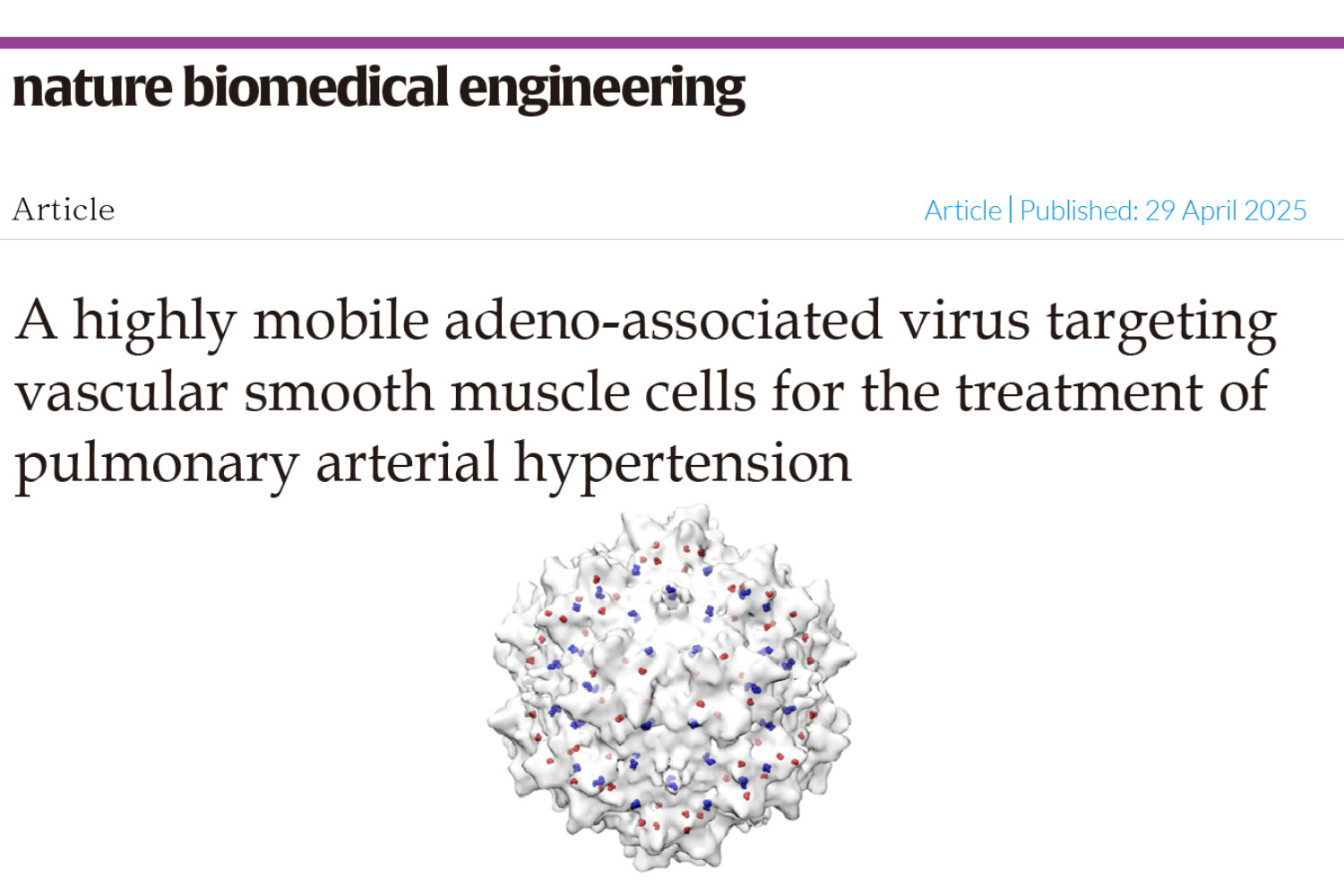
GluGene Therapeutics announced the publication of its research demonstrating the potential for a fundamentally curative gene therapy for pulmonary arterial hypertension (PAH) in Nature Biomedical Engineering on April 29, 2025. The study provides strong scientific validation of the company’s proprietary AAV engineering platform and establishes a new direction for in vivo gene therapy targeting highly inaccessible cell populations.
As a company focused on the development of next-generation gene therapies, GluGene Therapeutics generated highly diverse AAV libraries and applied directed evolution to create a novel class of highly diffusive, precision-guided AAV vectors. By systematically enhancing intratissue diffusion while preserving cell-type specificity, the company developed an engineered AAV variant (AAVp2CV) capable of selectively accessing pulmonary arterial smooth muscle cells (PASMCs)—a target long considered impractical due to their deep vascular localization and widespread distribution throughout the pulmonary circulation. Using this vector, the therapeutic gene FGF12 was efficiently delivered to PASMCs throughout the pulmonary vasculature, resulting in robust disease-modifying efficacy and advancing the pipeline into a product development phase.
The published study establishes the scientific foundation of GluGene Therapeutics’ AAV engineering platform by addressing one of the most persistent challenges in in vivo gene therapy: achieving precise delivery to deeply embedded, spatially dispersed cell populations. Historically, PASMC targeting has been considered nearly unattainable because conventional AAV vectors lack the capacity to traverse multiple physical barriers, including airway mucus, epithelial layers, interstitial spaces, and vascular structures. Through its directed evolution-based ATLAS platform, GluGene Therapeutics identified intratissue vector mobility as a critical and systematically tunable determinant of effective in vivo targeting and developed a novel AAV variant that combines exceptional tissue-level diffusion with high PASMC specificity. The findings demonstrate that enhanced intratissue diffusion can be optimized without compromising cell-type specificity, yielding a clinically actionable AAV vector capable of selectively targeting PASMCs and overcoming long-standing biological and engineering barriers in pulmonary vascular disease.
The research was conducted through close scientific leadership and collaboration between GluGene Therapeutics’ Chief Technology Officer, Jae-Hyung Jang, Professor in the Department of Chemical and Biomolecular Engineering at Yonsei University, and Wonhee Suh, Professor in the College of Pharmacy at Chung-Ang University, together with the company’s internal research team and the cardiology research group at Seoul National University Hospital (SNUH). Building on extensive multidisciplinary validation, GluGene Therapeutics is now independently advancing non-human primate targeting studies to further strengthen translational robustness and is actively expanding discussions with global pharmaceutical partners.
Beyond its immediate relevance to pulmonary arterial hypertension, this work introduces a new paradigm in AAV development by treating vector mobility and tissue-level diffusion as tunable design parameters. In this context, the study positions GluGene Therapeutics’ platform as a robust foundation for accessing previously unreachable tissues and cell types, with broad implications for next-generation gene therapies, strategic partnerships, and long-term commercial value.
GluGene Therapeutics Publishes Breakthrough Precision-Targeted AAV Platform for Pulmonary Arterial Hypertension in Nature Biomedical Engineering